
RC Car Motor Guide: Brushless Motors, ESCs & Electric Upgrades

Let's get straight to it: picking the right motor and ESC for your RC car comes down to matching motor size, Kv rating, and power specs to your ESC's capabilities. Get it right and your car runs like a dream. Miss something and you're looking at burned components, sluggish performance, or, worse, both.
To avoid the latter from happening, this guide walks you through the essentials of upgrading your weekend basher, crawler, 1/10 buggy, and anything else in between. This way, you can buy and race with confidence on your way to track domination (which is a step before world domination).
Let's begin by defining what these RC car parts are.
What Is an RC Car Motor?
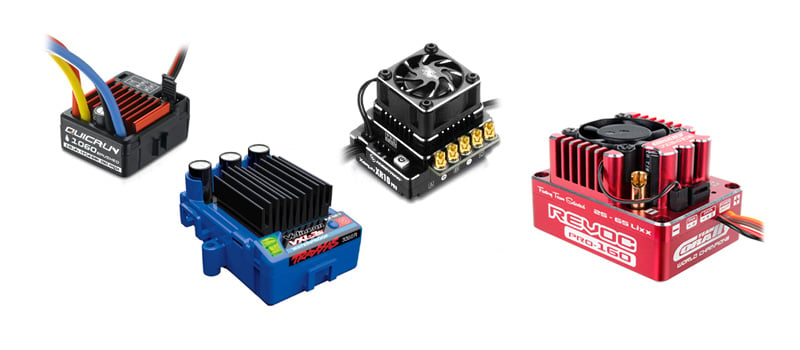
An RC car motor converts electrical energy from your battery into the rotational force that spins your wheels. It sits at the center of your power system, working alongside the electronic speed controller (ESC) to deliver controllable speed and torque on demand.
You'll run into two main types:

Brushless Motors
Brushless technology has matured significantly over the past 15-20 years. For the majority of RC drivers today, brushless is the smarter choice.
Brushless motors deliver higher efficiency, more power, and virtually zero maintenance. The magnets sit on the spinning rotor while copper windings surround them in the motor housing. Without brushes rubbing against a commutator, you eliminate brush wear, spark buildup, and a major source of heat. Most modern 1/10 and 1/8 scale vehicles run brushless systems for exactly these reasons.


Brushed Motors
Brushed motors still excel where smooth, controllable low-speed operation matters most. A 540 crawler motor rated at 35T or 55T delivers precise throttle response that rock crawling demands. They also cost less upfront, which is why they remain common in entry-level RTR vehicles.

If you're making the jump from brushed to brushless, remember that you'll need a new ESC as well. Brushed and brushless speed controllers aren't interchangeable, so budget accordingly. For a step-by-step example, our Tamiya TT-02 brushless upgrade guide shows exactly what's involved.
Finally, check out our guide on brushed vs brushless motors for a deeper comparison.
Understanding Kv Ratings and Turns
Motor power gets expressed two ways: Kv ratings for brushless motors and turn counts for brushed motors.
Kv measures RPM per volt of input. A 3000Kv motor on a 2S LiPo (8.4V fully charged) spins at roughly 25,200 RPM unloaded. Higher Kv means more RPM but less torque per amp.
But here's where new drivers get tripped up: higher Kv doesn't automatically mean faster. A 4000Kv motor has to work much harder to accelerate a heavy truck than a 2400Kv would. That extra effort generates heat and drains batteries faster. For monster trucks and heavier rigs, a lower Kv motor with proper gearing often delivers better real-world performance.
These Kv ranges give you a solid starting point based on what works well for most drivers:
| Vehicle Type | Recommended Kv Range | Typical Battery |
|---|---|---|
| 1/10 2WD buggy or truck | 3000-4000Kv | 2S LiPo |
| 1/10 4x4 short course | 3200-3800Kv | 2S-3S LiPo |
| 1/10 touring car (sport class) | 3500-4500Kv | 2S LiPo |
| 1/10 crawler | 1200-2100Kv | 2S-3S LiPo |
| 1/8 buggy | 1900-2200Kv | 4S LiPo |
| 1/8 truggy or monster truck | 1650-2250Kv | 4S-6S LiPo |
Turn counts, on the other hand, work in the opposite direction. They indicate how many times wire wraps around each pole of the stator. Fewer turns equals more speed and less torque. More turns equals less speed and more torque. A 13.5T motor is noticeably faster than a 17.5T. A 21.5T provides more controllable power for beginners or heavier vehicles.
Sensored vs Sensorless Brushless Motors
Once you've decided on brushless, you'll encounter another choice. The difference comes down to how the ESC knows where the rotor is positioned.
Sensored Motors
Sensored motors include small hall-effect sensors inside the motor housing that constantly report the rotor's exact position back to the ESC. This lets the ESC fire the motor phases in perfect sequence from the very first millisecond of throttle input.
The result is buttery-smooth operation from a dead stop through full throttle, with no stuttering or hesitation. Competition racers strongly prefer sensored setups because consistent launches and precise corner exits can make or break a race. If you're running sensored, you'll need a quality sensor cable to connect the motor to your ESC.

Sensorless Motors
Sensorless motors take a different approach. They rely on back-EMF, the electrical feedback naturally generated by a spinning motor, to determine rotor position. This works perfectly once the motor is turning, but at very low speeds or from a complete standstill, you might notice some "cogging." That's the slight jerkiness or stuttering as the ESC figures out where the rotor sits. It's not a defect; it's just how sensorless operation works at low RPM.
The good news? Sensorless motors cost less, have fewer parts that can fail, and perform beautifully for bashing and higher-speed driving where that initial low-RPM smoothness isn't a priority.
For crawlers where low-speed control really matters, a sensored system like the Hobbywing Xerun AXE makes a noticeable difference. Most quality ESCs today support both sensored and sensorless operation, so a dual-mode controller gives you flexibility to run either type depending on your needs.

What Does an ESC Do?

On the other end of the spectrum is the ESC (electronic speed controller), which manages power flow from your battery to the motor based on throttle input from your transmitter. It acts as the brain of your power system, deciding how much juice reaches the motor at any given moment. If you're new to ESCs, our article on what an ESC does breaks down the basics.
Here's the critical part: your ESC must match your motor type. For instance, a brushed ESC only works with brushed motors, and a brushless ESC only works with brushless motors. There's no mixing these two, so double-check compatibility before you order anything.
Beyond motor type, your ESC also needs to handle the following:
Battery Voltage
Most ESCs support 2S or 3S LiPo batteries, though some handle 4S, 6S, or even 8S for monster trucks and large-scale rigs. If you're unsure which battery to pair with your system, our guide on the best LiPo batteries for RC cars can help.

Motor Power Rating
ESCs also have motor limits expressed in Kv or turns. If your ESC is rated for 8.5T minimum, you'll need a motor with 8.5 turns or more. And if you're running a sensored motor, make sure your ESC actually supports sensored operation, otherwise you'll be running it in sensorless mode anyway.
Sensor Requirements
Quality ESCs from brands like Hobbywing and Castle Creations typically offer better throttle feel, more programmable features, and longer service life. If you're running Hobbywing, our Hobbywing settings explained guide walks you through the programming options.
Speaking of longer service life, many ESCs also come with waterproof designs that hold up well for bashers and crawlers running through puddles and mud. Adding a cooling fan or heatsink helps keep temperatures in check during longer runs.
RC Motor Sizes: 540 vs 550 vs 1/8 Scale

Motor size tells you what fits your chassis and roughly how much torque the motor can produce. And those numbers you see on motors refer to physical dimensions, not power output (different types of RC cars use different motor sizes based on their weight and intended use).
Here's a quick of these dimensions:
| Motor Size | Diameter | Length | Typical Applications |
|---|---|---|---|
| 370/380 | ~28mm | ~38mm (approx.) | 1/18 and 1/16 mini RC cars |
| 540 | 36mm | ~50mm | 1/10 touring cars, buggies, 2WD trucks |
| 550 | 36mm | 55-90mm | 1/10 4x4 short course, monster trucks |
| 4268 | 42mm | 68mm | 1/8 buggies, lighter truggies |
| 4274/4076 | 42mm | 74-76mm | 1/8 truggies, monster trucks |
One thing that catches people off guard: shaft diameter varies by motor size. Most 540 motors use a 3.175mm (1/8 inch) shaft. Many 550 and 1/8 scale motors step up to a 5mm shaft, which means your pinion gears won't be interchangeable between sizes. Mounting hole positions also differ, so always confirm your motor will actually bolt into your chassis before clicking "add to cart."
Let's talk about each one in full detail.
540
The 540 is the most common motor size in the hobby. These measure about 36mm in diameter and 50mm in length. If you've got a 1/10 scale touring car, buggy, or 2WD truck, chances are it runs a 540-size motor. Most aftermarket motors are designed around this form factor.
550
Moving up, 550 motors share the same 36mm diameter but stretch to about 55-90mm in length depending on the specific model. That extra length means a longer rotor, which translates to more torque. You'll find these in heavier 1/10 vehicles like 4x4 short course trucks and monster trucks where the added grunt helps move more weight.

1/8 Scale
For 1/8 scale vehicles, motors get bigger still. A 4268 motor measures 42mm in diameter and 68mm in length. The 4274 and 4076 variants extend to 74-76mm. These power 1/8 buggies, truggies, and full-size monster trucks where torque demands are considerably higher.
How to Match Your ESC to Your Motor
Getting this pairing right is non-negotiable. A mismatched ESC and motor can result in anything from poor performance to fried electronics. Here's what to verify before you buy:
- Confirm motor type compatibility. Brushless motors require brushless ESCs. No exceptions.
- Check sensor support if you're planning to run a sensored motor. Not all ESCs handle sensored operation, and some only run sensorless regardless of what motor you connect.
- Verify the ESC's power rating against your motor. ESCs specify minimum turn ratings or maximum Kv limits for good reason. Connecting an 8.5T motor to an ESC rated for 10.5T minimum will overwork the controller and likely cause it to overheat or fail.
- Make sure your ESC supports your intended battery voltage. Running 3S through a 2S-only ESC is a quick way to release the magic smoke.
When in doubt, buying a matched ESC and motor combo takes the guesswork out of the equation. Hobbywing, Castle Creations, and Traxxas all sell pre-matched systems that ship wired, programmed, and ready to install. These combos often include the sensor wire and come with sensible default settings that work right out of the box.
Upgrading Your RC Car Motor
Motor upgrades rank among the most popular RC car upgrades in the hobby, and it's easy to see why. More power, better efficiency, and improved throttle response can completely transform how your car drives.
That said, a successful upgrade takes a bit of planning before you click "add to cart."
Pre-Upgrade Checklist
Start by confirming your new motor will physically fit. Check that your chassis accepts the mounting pattern and that the shaft diameter matches your current pinion gear. Most 540-to-540 swaps are plug-and-play, but jumping to a different size class means verifying mount holes and possibly sourcing new gears.

You'll also want to make sure your ESC can handle the new motor's power output. If you're switching from brushed to brushless, plan on replacing the ESC too, and double-check that your batteries and charger can keep up with the added demands.
Our guide on how to make an RC car faster covers more ways to get the most from your setup.
Gearing and Temperature
Once the new motor is installed, gearing becomes your next focus. Higher Kv motors spin faster, which generates more heat throughout your drivetrain. Start with the motor manufacturer's recommended pinion size, then fine-tune from there based on how hot things get.
After your first run, check the motor temperature with an infrared temp gun or the finger test: if you can't hold your finger on the motor can for two to three seconds, it's running too hot.
For best motor life, keep temps below 160°F (70°C). Anything above 180°F (82°C) risks permanent magnet damage, so if you're in that range, drop a tooth or two on the pinion and run again.
Getting into the habit of checking temps after runs will save you from burned motors down the road. Our basic car maintenance guide covers what else to look for, and the electric motor maintenance video walks through keeping your motor in top shape.
RC Car Motor and ESC FAQs
How do I know if my RC car motor is bad?
Know your RC car motor is bad if it shows poor performance, excessive heat, strange noises, or won’t spin under throttle. A burned smell or visual damage also confirms motor failure. Test by removing the motor and applying direct power to check if it runs smoothly or not.
Can I use any motor in my RC car?
You cannot use any motor in your RC car. The motor must match the ESC type (brushed or brushless), size, power rating, and voltage compatibility. Using the wrong motor can damage components or reduce performance. Always verify physical fit and shaft size before installation.
What causes an RC car motor to overheat?
An RC car motor overheats due to improper gearing, excessive Kv rating, overvoltage, or poor ventilation. Running a motor beyond its rated limits or using mismatched ESC settings can also raise temperatures. Always monitor heat and keep motor temps below 160°F (70°C).
How do I break in a new RC car motor?
Break in a new brushed RC car motor by running it at low voltage (3-4V) for 15-20 minutes with no load to seat the brushes. Brushless motors do not require break-in. Proper break-in extends motor life and ensures smoother operation under load.
Put Your New Motor to Work
With the right motor and ESC paired up, the next step is getting out and driving. Start with conservative gearing, run a few packs, and check your temps after each session. Make small adjustments until you find the sweet spot between speed and reliability. Once you've dialed it in, you'll feel the difference immediately, whether that's faster lap times, smoother crawling, or longer run sessions without overheating.
Once you're ready to upgrade, browse our brushless motors, electronic speed controllers, and ESC motor combos to find the right match for your RC car. Need help choosing? Contact us and our team will point you in the right direction.

About us
News
Contact us
EuroRC Oy
Päiviöntie 8
12400 Tervakoski
044-3397420
info@eurorc.com
www.eurorc.com
FI23527868
Payment methods



Shipping Methods