
RC Connectors Explained
Most Common RC Connectors Explained

XT-60.. JST.. Bullet.. and who the heck was Deans? Electrical Connectors used in RC may be very confusing for beginner and sometimes even for us who have been in the hobby longer time. Let's take a quick look for most commonly used connectors in the RC world and figure out what they are used for!
We can divide our RC connectors, cables and adapters roughly in two categories. First are Battery Connectors and other is General or Other Connectors.
RC Battery Connectors can withstand strong currencies and are built strong. Sturdy structure ensures that they can be connected and disconnected hundreds of times as you need to remove them from the car to recharge them.
These connectors are often also very colorful that helps you locate and indicate them. Depending of the type, RC Battery Connectors can withstand very high currencies and voltages.
General Type RC Connectors are usually smaller and are commonly used in other areas of electronics also. These are usually for low-current voltages (6V-12V) and should never be used as battery connectors.
There are many different types and standards out there and it is very easy to get confused. If you are not sure what cable or adapter you need, please contact our EuroRC Customer Service (send us a photo!) and we will search right solution with you.
Please Note! Use only high quality connectors - stay away from cheap crap.
Find our RC Cables, Connectors and Adapters here. Use search to narrow selection.
Read more: How to Solder RC Connectors

Basic Connector Terminology: Cable - Terminals (with soldering tabs) - Housing.
RC Battery Connectors
Bullet / Banana
Some say Banana, I say Bullet! This connector is easy yet fast to use and they can handle very high currencies and voltages.
It is simple to solder in and more than quick to disconnect but as both of the cables can move freely there is a high change and danger of short circuit if the cables are connected to the battery but not in the car.

There are many sizes of these available. In Radio Control Cars most commonly used are sizes 4mm and 5mm.
There is also no other indicator than color of the cable that tells you if it is the positive or negative power cable. If (or when!) you connect this type of battery backwards (wrong polarity) you can easily burn the sensitive electronics in your car and it will happen fast!
It is anyhow a very good and pretty safe connector type when used in battery chargers. Many chargers use this as a standard as it allows the user to use many different type of charging cable. Please note that open cable ends are still very easy to short circuit so remember to remove your charging cable from the charger after you're done!
This connector type is only suited for "those who know what they are doing", ie. more experienced hobbyists and professional RC drivers.
Types: 2mm-8mm (most common sizes used in RC)
Current Rating:
- 2mm Bullet: 25 A
- 3.5mm Bullet: 50 A
- 4mm Bullet: 90 A
- 5mm Bullet: 120 A
- 5.5mm Bullet: 130 A
- 6.0mm Bullet: 150 A
- 6.5mm Bullet: 160 A
- 8.0mm Bullet: 200 A
Cable used:
- 2mm Bullet: 20 AWG
- 3.5mm Bullet: 16 AWG
- 4mm Bullet: 14 AWG
- 5mm Bullet: 12 AWG
- 5.5mm Bullet: 12 AWG
- 6.0mm Bullet: 10 AWG
- 6.5mm Bullet: 10-8 AWG
- 8.0mm Bullet: 8 AWG
Where to use: Chargers. Professional RC and serious hobby level. Not recommended for beginners
Pros: Cheap, durable. Fastest and easiest to use when you know what you are doing. Fast to solder.
Cons: Very high risk of short circuit. Easy to connect wrong. Fire hazard.
Used by: Many chargers (please use adapter cable!). Competition level RC batteries.

4mm Bullet is widely used in RC Chargers. When the charging is ready, remember to disconnect the battery from the cable first!
Deans, T-Plug
Deans (or T-Plug, or "Red Connector") was one of the first connector types that could withstand high voltages of modern LiPO (Lithium Polymere) batteries and it become as industry standard pretty quick. For today, it may be a bit old fashioned but being simple and most importantly cheap it is very popular RC-lipo connector still today.
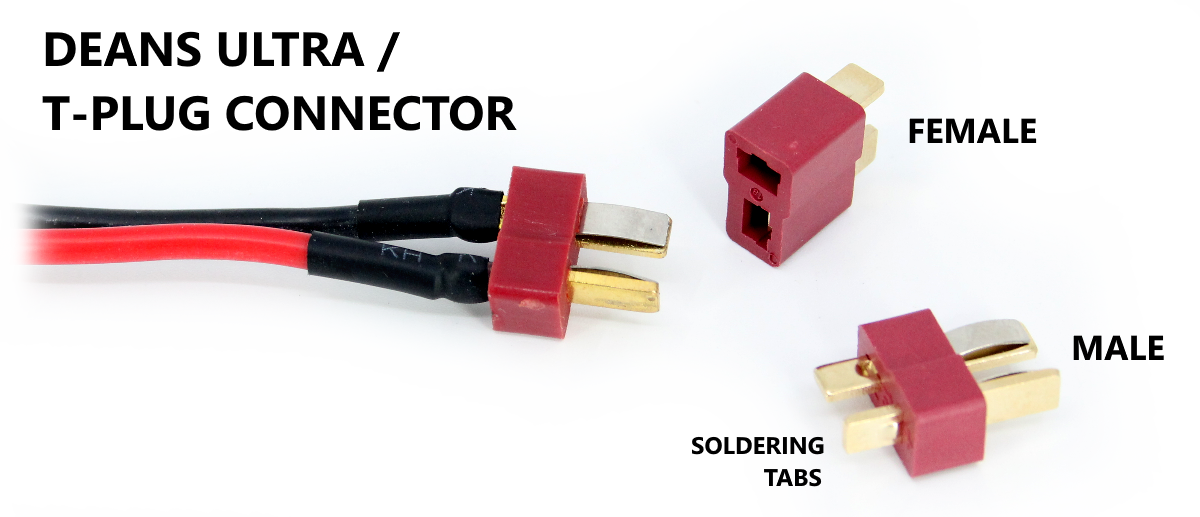
Deans connector can be found from many RTR-cars that are equipped with brushless electronics and are supposed to be run with LiPO battery.
This connector has two spring-loaded terminals in 90 degree angle to each other. When done right, it is impossible to connect it wrong what makes it very safe for even beginner to use. It is anyhow pretty small and many people find it hard to connect as it can be very tight.
When soldering Deans connectors, remember that plastic body cannot take very high temps for long time and may even melt if you are not quick enough.
Types: Deans / T-plug. Micro-Deans
Current Rating: 60A / 75A
Cable used: 14 AWG recommended
Where to use: Deans is best used with 2S-3S LiPO configurations.
Pros: Small. Cheap. Pretty simple to solder. Tight connection. Cannot be connected wrong way.
Cons: Cheap. May be tricky to use due the tight connection. Not suitable for strong currents.
Used by: HPI Racing, Maverick RC. Very common. 1/10 size of RC Cars
Did you know.. First and original Deans Ultra Plug-connectors were designed and manufactured in WS. Deans of Los Alamitos, California USA, giving them the later nickname of Deans-connector.
XT-60, XT-90, XT-30
XT-connectors are newer by their design and are may ways more convenient to use in daily RC than older T-plug type. These have round, spring loaded and gold plated Bullet type of terminals that are molded in strong, heat resistant nylon housing. Terminals cannot be separated from the connector housing. XT-connectors can be connected one way only and have typically yellow or black color.

These connectors are getting more popular every year and many newer RC chargers use XT-60 as default battery connector, replacing the traditional 4mm Bullet lead.
There are 3-different sizes of XT-connectors used commonly in Radio Control Hobby.
Smallest XT-30 is not commonly used as battery connector in RC cars but can be used to connect auxillary equipment such as servo or winch. Can be used as Receiver Battery connector. Uses and fits to 2mm bullet connectors.
Medium sized XT-60 is for many the only connector they want to use and many hobbyist replace default T-Plug connectors to these before they drive their car. Uses and fits to 3.5mm connectors.
Larger XT-90 is often used in 1:8 and large scale of RC cars as they deal with very high currents and bursts while being easy and safe to connect. Uses and fits to 4.5mm bullet connectors.

Newest version of original XT-60 connector uses gray or black cable cover and does not necessary need heat shrink. Use only high quality connectors. Do not buy the cheapest!
Types: XT-30, XT-60, XT-90
Current Rating:
- XT-30: 15A/30A (recommended)
- XT-60: 30A/60A (recommended)
- XT-90: 60A/90A (recommended)
Cable used:
- XT-30: 16-18 AWG
- XT-60: 14-12 AWG
- XT-90: 12-10 AWG
Where to use: In everyday RC Car use from batteries to ESC etc. connectors. Very recommended.
Pros: Cannot be connected wrong way. Easy and safe to use. Good grip and very strong connector body. Pretty easy to solder (watch out for high temp or the plastic body may melt!)
Cons: Larger size makes things tight sometimes. Requires heat shrinks.
Used by: Team Corally, Hobbywing. RC Chargers. Popular aftermarket connector. Use XT-60 in 1/10 size RC cars and XT-90 in larger, 1/8 cars and bashers.
Did you know.. Original manufacturer and patent holder of the original design for XT connectors is Amass Electronics.
Team Corally PRO 3.5mm Connector
Resembling very much original XT-60 connector is the Team Corally PRO 3.5mm connector. It is as handy as XT-60 but has longer plastic tabs inside the connector to prevent it being connected in reverse polarity.

These make a great alternative for XT-60 connectors.
Types: TC PRO 3.5mm
Current Rating:
- TC PRO 3.5mm: 30A/60A (recommended)
Cable used:
- TC PRO 3.5mm: 14-12 AWG
Where to use: In everyday RC Car use from batteries to ESC etc. connectors. Alternative for XT-60
Pros: Cannot be connected wrong way. Easy and safe to use. Good grip and very strong connector body. Pretty easy to solder, use heat shrink.
Cons: Does not fit to XT-60 due polarity protection.
Used by: Team Corally.
Did you know.. Team Corally has wide selection of quality RC accessories available. Check them out!
EC-3, EC-5, EC-2
Like their brother XT-connector, EC-connectors use also standard sized Bullet terminals equipped in strong plastic heat resistant nylon body.
What is different is that pins of EC-connector are separate from the body while in XT-connector they are molded in the connector housing. This makes the soldering process bit easier as you first solder the lead in to tab and then put it into connector body afterwards.

EC-connectors are traditionally dark blue by their color.
Types: EC-2, EC-3, EC-5
Current Rating: Same as same size Bullet Connectors
Cable used:
- EC-2: 16-14 AWG
- EC-3: 12-14 AWG
- EC-5: 12-10 AWG
Where to use: In everyday RC battery use.
Pros: Can withstand strong currents. Very easy to solder. (remember the polarity!) Heat shrink not required.
Cons: Large size. Not as strong built as XT-connectors.
Used by: RC Helicopters and Drones. Popular aftermarket connector. Fits ARRMA IC-connectors. Use EC-3 in 1/10 size RC cars and EC-5 in larger scale, 1/8 cars and bashers.
Did you know.. EC-connectors fit directly for IC-connectors used by ARRMA but do not include the third terminal.
IC-3, IC-5
IC-connectors can be seen as evolution version of EC-connector family. These are backwards compatible meaning that you can use batteries with EC connectors in RC car that equips IC-connectors. Batteries with IC-connectors can be only charged with Spektrum Smart -battery chargers.

Biggest difference is third tab that can be used to transfer info and also as balancer connector. IC-3 and IC-5 are developed and patented by Spektrum Smart Technologies.
Types: IC-3, IC-5
Current Rating: Same as same size Bullet Connectors
Cable used: 16-12 AWG
Where to use: In ARRMA vehicles only.
Pros: Good grip with strong connector body. Third pin for Smart features.
Cons: May be tricky to solder due the third pin. Expensive connector.
Used by: ARRMA and Spektrum Smart Technologies. Horizon Hobby. Axial.
Did you know.. Spektrum Smart batteries have integrated memory chip that storages data from charging cycles etc!
TRAXXAS iD, TRX (old version)
Traxxas wants to make things easy to use for customers. This is why they have developed their own, patented battery connector that can be used only in their cars and only with their Easy-To-Use battery chargers.
Newer style TRX iD connector has integrated balance leads built-in to body while the older version uses separate balance lead. Traxxas connectors are backwards compatible.

Traxxas iD technology also makes for very convenient and secure battery charging as this technology eliminates complicated charger programming by automatically configuring and optimizing the charge settings for Traxxas iD batteries.
When soldering Traxxas connectors, first solder the leads to tabs and push them in to connector housing afterwards.

Left: New Traxxas iD connector with integrated balance connector. Right: Older style TRX-connector with separate balance connector
Types: TRX iD, "TRX" (old, pre-2017)
Current Rating: 60A / 75A (recommended)
Cable used: 12 AWG
Where to use: In Traxxas vehicles only
Pros: Super Easy and safe to use. Good grip. Cannot be connected wrong due large plastic tab (do not remove the tab!) Easy to solder.
Cons: Expensive. Large size. Suitable only for battery connector.
Used by: Traxxas
Did you know.. Traxxas Connector has 24.5 times less resistance than a Molex connector
Tamiya, Tamiya Mini
Grandmother of all RC Battery connectors, immortal Tamiya-connector stays popular decade after decade. Originally introduced already back in the 70's, this lightweight and easy-to-assemble connector can be still found from many RTR RC Cars that equip NiMH-batteries. Many smaller sized cars also use Tamiya Mini -connector. Tamiya connector cannot be connected wrong way and it has a plastic clip to keep it connected.

While bit (or very) outdated, the Tamiya connector is still valid today and is very suitable for low current applications. It is not recommended to use with LiPO-batteries and may even melt or catch fire if used with high powers.
Normal sized Tamiya-connector is white and slightly transparent. Mini version has light green color.
Tamiya connectors are easy to solder. Solder or crimp the leads to terminals and push them in to housing afterwards.
Types: Tamiya, Tamiya Mini
Current Rating: 15A
Cable used: 20-14 AWG
Where to use: In beginner level RTR cars. Tamiya cars. Receiver battery.
Pros: Very common and very popular still today. Easy to solder and assemble.
Cons: Not suitable for high currents by any means. Flimsy, not very durable design.
Used by: Tamiya. Many budget level RTR Cars with NiMH battery. Maverick RC. Airsoft guns. Use Tamiya Mini in small scale (1/24, 1/18 etc.) of RC cars and Tamiya connector up to 1/10 of size.
Did you know.. In some cases, Mini-Tamiya connectors are wired in reverse polarity. This is often the case with airsoft guns, where the square profile terminal is the negative terminal and the rounded terminal is the positive terminal.
General Use RC-Connectors
Futaba/JR/Hitec RX etc. Servo Connectors
Servo connectors are standard in world of Radio Control Hobby and have been used since early days of RC. Some manufacturers use slightly different housings.

in RC, Futaba/JR type of cables and connectors are used basically always when something is connected to Radio Receiver (RX) of your application. There is three cables (3-pin) where two are for currents (+/-) and one is to carry signal. Usually there are normal red (+) and black or brown (-) wires and for signal the colors yellow and white are commonly used. Whole cable may be also single color. Remember to confirm the polarity!
Futaba type of housing has a little tab to prevent it to be connected wrong way while JR/Hitec have a little bevel at the bottom of the housing.
These are easy to build. Solder or crimp the cables to terminals with pliers or crimping tool and push them in to housing.
Types: Futaba, JR, Hitec. "Servo Cable"
Current Rating: 3A (recommended)
Cable used: 28-24AWG recommened. More powerful servos 20AWG
Where to use: Receiver, Servo, ESC, RC light kits, Telemetry etc.
Pros: Used everywhere. Easy to expand with Y-cable. Easy and fast to build.
Cons: They maybe not the best solution to power your RC accessories and gadgets.
Used by: Every manufacturer.
Did you know.. These use just everyday industry standard 0.1" terminals found from almost every computer etc device worldwide.
JST-XH, Balancer Cable Connector
This maybe a little confusing as there is a large amount of different kind of JST-connectors available. In RC Cars we usually use just the JST XH and JST RCY-family.

JST-XH can be most commonly be found from LiPO-battery balancer cables. They are built in same say than JR-connectors but are bit larger and can withstand higher voltages than servo cables. These connectors may have different amount of pins, especially with LiPO balancer cables.
JST-XH connector housings are typically white in color.
They are built crimping the cables to terminals and pushing them in to housing. Use crimping tool.
Types: Number of pins depends on the amount of cables. 2S balancer connector has 3 pins, 4S has 5 pins etc.
Current Rating: 3A
Cable used: 30-22 AWG
Where to use: Battery balancer cables and balancer boards.
Pros: Reliable and easy to use. Does not lock but fits tight.
Cons: Not for high currents. Does not lock.
Used by: Most RC LiPO battery manufacturers like Gens ace, Team Corally, HPI Racing..
Did you know.. JST-XH connectors were developed by J.S.T. Mfg. Co. (Japan Solderless Terminal). They can be easily confused with Molex connectors.
JST-RCY, BEC Connector
This is the two pin (2-pin) red connector you may find powering your RC auxillary equipment. Also commonly used in external BEC (Battery Elimination Circuit) and as radio transmitter or receiver battery. It has longer, more sturdy housing and it also locks in to place with small plastic tab.
Larger terminal size means that it can withstand higher voltages than XH. Due its size it is also more convenient to use than clumsy Futaba connector. Use crimping tool or pliers for cable connection and push terminal in to housing.

Types: JST RCY. Often called just "JST-connector" or BEC connector.
Current Rating: 5A/10A (recommended)
Cable used: 28-22 AWG
Where to use: BEC and RC Crawler Winch. Transmitter and receiver battery
Pros: Reliable and easy to use. Strong housing. Locking type.
Cons: Can be used only for 2 cables. Does lock.
Used by: Many manufacturers.
Did you know.. There is no such thing as "JST-connector"-only. In world of RC we use commonly JST-XH or either JST-RCY connectors.

Remember to always storage your RC Adapters and Cables in good order. Especially smaller terminals can be easily confused with each other. Use Storage Box with dividers and keep it in dry place.
Search for Storage Boxes here!
Remember that our EuroRC Customer Service will always help you regarding your questions!

About us
News
Contact us
EuroRC Oy
Päiviöntie 8
12400 Tervakoski
044-3397420
info@eurorc.com
www.eurorc.com
FI23527868
Payment methods



Shipping Methods